Saturday, September 26, 2015

High Concept Design Meets Bureaucratic Park Maintenance

When gardening columnist Adrian Higgins wrote about landscape architect Ching-Fang Chen in an August feature article in The Washington Post, it immediately caught my attention. I had inside knowledge through a friend and colleague about Chen's struggle to keep intact a recently installed agricultural-inspired sculpture she had designed for Little Bennett Park in upper Montgomery County Maryland, located 30 miles northwest of Washington, DC.  The demise of her hay bale sculpture-cum-sound barrier, only a year after it had been built, was the jumping off point for Higgins's profile about her.
Hay Bales arriving at the park 
As Higgins notes, Chen went from more than a decade designing stylish private gardens for the acclaimed Washington, DC, design firm Oehme van Sweden & Associates to her current position, working for the Montgomery County Maryland Parks Department.  Despite working for the last six years in a culture with a "traditionally low-rent aesthetic,"  Chen has maintained  "her uncompromising  passion for imaginative design,"  says Higgins.  And, theoretically, Chen's switch from the private to public realm should offer many more people the chance to experience her work.

It seems promising that a forward-thinking landscape architect would focus her talent on the less revered design standard of suburban parks, no?   Well, when her "high concept" art installation met bureaucratic park maintenance, Chen's design was dismantled prematurely. Not a trace of it remains.


I'm betting I'm one of the few visitors to ever see the giant hay bale sculpture in Little Bennett, and I'm going to share some photos of it as it was being constructed and as well as views of it complete.  You can decide what you think.

As to the inside knowledge I mentioned earlier:  I know the talent that built the hay bale walls.  When Rob Page, a stone mason with an artist's sensibility whose work I've admired for years, mentioned he was working on the project, my curiosity was peaked.  It certainly wasn't his usual gig.  (He and his crew did build an elegant stone wall and some other stonework on the site.)  So I drove out to see what he was creating.

MD Rte 355 is the road on the left.  

Bales not yet put in place.  Picnic tables are now located under the oaks to the right. The stone wall delineates what is now a parking area where the hay bales sit.  

Looking south into the fields of Little Bennett

Yes, I climbed atop these pyramids to take pictures and all I could think was: wouldn't any kid (or adult for that matter) want to do the same? They seem to cry out to be climbed if only to get a better view of the surrounding landscape. (Those ladders are only temporary.) Yet we live in a culture of hyper-vigilance about the liability of any and all potential accidents waiting to happen, so I was surprised but impressed, and a little amused, that somehow this idea passed muster with the parks department. 


Any farm-raised kid knows the entertainment value of jumping off hay bales stacked in the barn. Could that be the point--fun?!  No fence or signage was planned to keep people off them, as far as I know.  It would be a relatively soft landing, however, if anyone fell as thick mulch was spread around the base.

The installation was by design an ephemeral piece -- the hay bales would gradually decay.  And sure enough they began to slump and grass grew on them in a relatively short time.  But here's the rub it seems -- maintenance wasn't on board with letting the hay bale wall decompose in place.  Unwanted critters showed up and they claimed the bales became unstable.

Granted, resources for public park maintenance are usually spread thinner than those for high-end private gardens.  As someone who maintains private gardens, I certainly appreciate concern for and investment in garden maintenance -- gardens are lost, literally, without it.  What was communicated to the maintenance crew in this case, I wonder?   The area was mown and tidied; the tall grass and weeds you see in many of my photos disappeared, so it definitely received some attention.   


Nevertheless, I was dismayed when I showed up in late July to find a blank slate where the round bales had been. I wanted to see the fine tuned finished product. Rob Page--no surprise--was disappointed when I told him what I'd discovered-- all that work erased!


Unfortunately, photographs by professional photographer Roger Foley didn't make it into The Post. But he graciously agreed to let me include a link to his gallery of shots showing the Day Use Area with both the hay bale installation still intact and the more recent addition of the spiky bamboo globes (pictured in The Post article). The effect was something special--the bamboo sculptures look like giant seed heads of ornamental onions (Allium christophii comes to mind) that alit on the ground near the picnic area and the hay bales like pastoral pyramids.

That's Ching-Fang and Rob Page down in front, with Rob's crew above
The outsize scale of these installations makes them visible from a distance and help create a sense of place, a little picnic refuge, out of what would otherwise be a a stark, nondescript parking area where few would want to linger.  If the hay bales weren't the most successful sound wall, they did  offer a satisfying visual barrier from the road.  Without their bold embrace, the picnic area feels decidedly less intimate.  Will something arrive to take their place?


Little Bennett Park is Montgomery County's largest park at 3,700 acres. Chen's plans for the park as outlined in Adrian Higgin's piece reveal some exciting an innovative features, sensitive to the area's natural assets.  Stay tuned and consider visiting the park's Day Use area in person.  


Friday, July 17, 2015

July Bloom Day (I'm late to the party!)


I have so enjoyed seeing what's blooming in others' gardens on Bloom Day.  It's a series of inspiring armchair garden tours, seeing what everyone grows that I do, or don't and wish I did, how they combine plants, and what they choose to highlight.  I'm finally participating with images from my own garden, though I'm several days late. For more Bloom Day coverage go to May Dreams Garden   So here goes:

Begonia 'Bepared' Dragon Wing Red


Clethra barbinervis,  Japanese  Clethra


Begonia (If anyone knows which one, I'd love to know)
Spirea, maybe 'Magic Carpet' ,  in a trough 

Astilbe chinensis 'Pumila' with Osmunda regalis to the left and Carex pensylvanica below

Alternanthera 'Purple Knight' with unknown Begonia 

Aesculus parviflora, Bottlebrush Buckeye


Rudeeckia volunteer 
Thalictrum rochebruneanum, Meadow rue


Agastache 'Summer Sunset' and  A. 'Tango' 
Eutrochium maculatum 'Gateway', Joe Pye Weed


Echinacea 'Ruby Star'
Hosta 'Sum and Substance' with Hakonekloa macra  'Aureola '  
Callirhoe involucrata, Wine cups

Eryngium yuccifolium, Rattlesnake master
Portulaca 'Pazazz' series ? 
Hydrangea quercifolia, (could be 'Snow Queen' ) Oakleaf Hydrangea
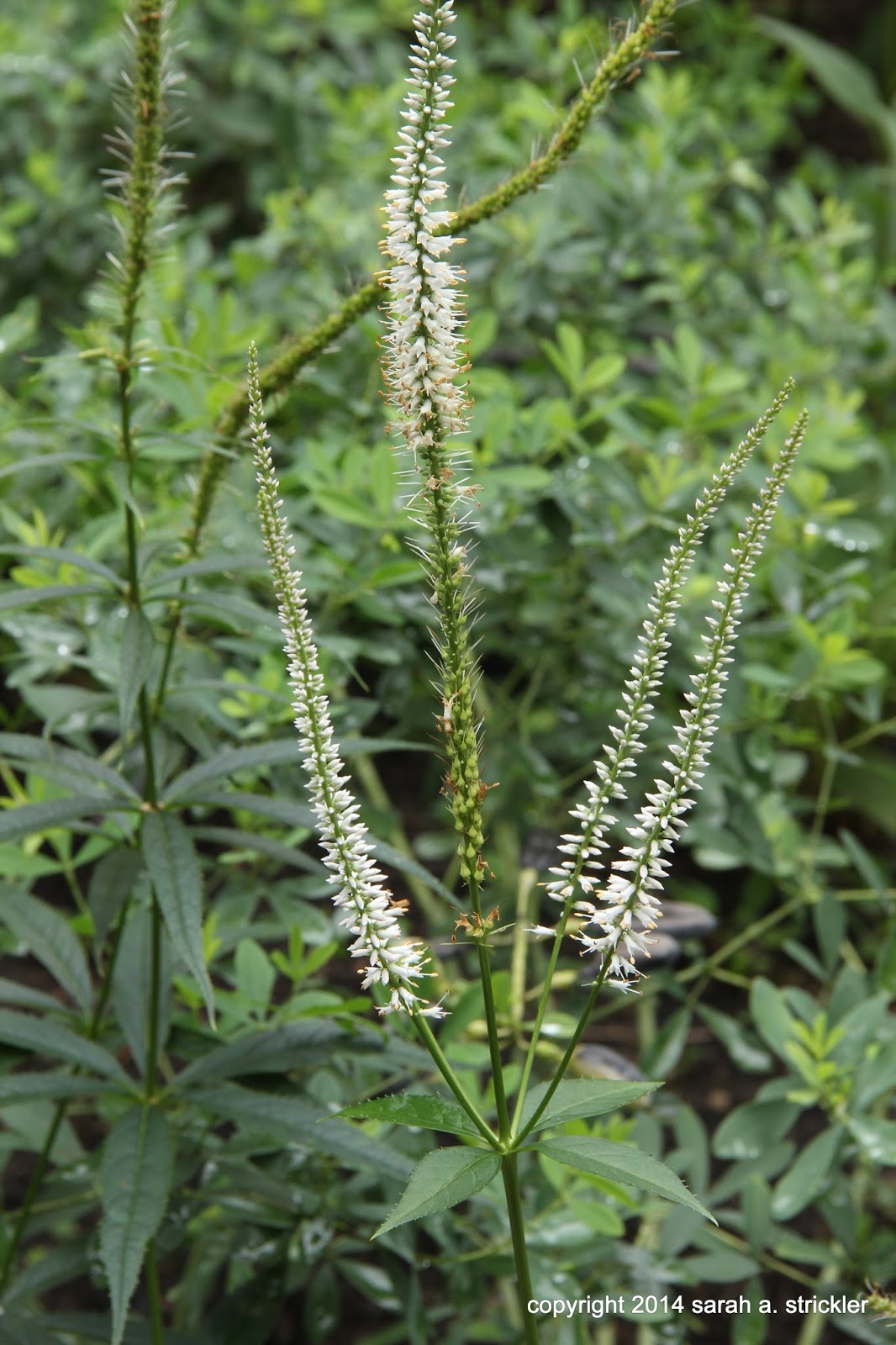
Veronicastrum virginicum 'Lavendar Towers', Culvers Root


Ligularia 'Desdemona' (I think)  in bud with Dryopteris goldiana 

Liatris spicata 'Alba',  Blazing Star, through the inflorescence of Calamagrostis 'Karl Foerster' 

The fruit on Rhus  'Laciniata' , Cutleaf  Sumac 

Rehmannia angulata  'Rufus', Chinese Foxglove 


Saturday, June 27, 2015

Cuckoo for Keukenhof: The Garden of Dutch Bulb Growers

I wasn't sure I wanted to visit what I thought might be a kind of "Disney Bulb Land" at the famous Dutch public garden of Keukenhof, but I'm glad I did.  After all, the story of bulb flora culture, especially tulips, is inextricably linked to the history of the Netherlands.  Most of Keukenhof's displays are designed by bulb companies.  Massing a single bulb variety seems to predominate, but they also demonstrate less rigid planting schemes.  Impressive mature shrubs and trees grow throughout the almost 80 acres of about 7 million bulbs and help to moderate what otherwise could be bulb over-stimulation. Several indoor pavilions were stuffed with extravagant displays of orchids and lilies, and a rather wimpy exhibit told the history of Tulipmania. 

Two connecting buses, about an hour ride total from Amsterdam, got me to Keukenhof.  (You can also take the train.) I visited in early May when there was still plenty in bloom and took these pictures with my cell phone, as I had filled the card on my camera and forgotten to bring an extra one.


This planting combination included single and double hybrids and species tulips, muscari, and anemone.  As one of the gardeners I spoke to told me, they can get about 9 weeks  of bloom out of some of the mixed plantings, which are so dense you need to get close to notice everything that is there.   


It's not just the bulbs, but the "window dressing" is pretty spectacular as well.  I love the geometry of these clipped trees and hedges, which set off displays of older varieties and species bulbs in this section.
An allee of Chestnut trees


A couple favorite old bulb varieties: Tulipa saxatilis, which produced the cultivar 'Lilac Wonder.' The straight species is native to Crete and western Turkey.  Below it is Narcissus triandrus, native to France, Spain and Portugal, a dainty daffodil producing multiple flowers on a single stem and commonly known as Angel's Tears because of the drooping flowers.  'Thalia' is commonly known cultivar.  


A staute of 16th century botanist Carolus Clusius (aka Charles de l'Ecluse) sits in the historic section of Keukenhof.   He established one of the earliest botanical gardens in Leyden and is credited with laying the foundation for the Dutch bulb trade. (More about him here.)  Tulipa clusiana 'Cynthia' is cultivar worth trying.    


At the edge of Kuekenhof is a classic Dutch view of the surrounding bulb fields -- here a swath of tomato-red--and the very flat, open terrain.


This was an amusing bit of fakery.  Don the hat, pick up the brush and palette, dab at the canvas provided and you can appear to be an artiste en plein air!   Pretty convincing, eh?  


A variety of containers


Not my favorite color combination, but I appreciate the variety of plants -- Euphorbia (polychroma?), Heuchera, Geranium 'Samabor', and Alchemila mollis.


Accompanying succulents!

And here too. 
Building the Lily display


Our native Cypripedium was represented in the Orchid display 

Those dark figures are women in burqas


A rain storm didn't keep this intrepid gardener from his work slicing off stems of spent flowers to keep things tidy.  Two gardeners (both men) told me that 50 gardeners plant all the bulbs starting the first of October and finishing by the end of December.  It is now done by machine, but not that long ago was done by hand.  Both of them have been at Keukenhof for about 20 years.  Once finished, all the bulbs are ripped out and discarded.  

The effects of botrytis, a common tulip fungus, is why hybrid tulip plantings in many public spaces and gardens are dug up and thrown out after blooming.  (It is done here in the Washington, DC.) The fungus is difficult to control and prevents many of the hybrids from re-blooming reliably from year to year.  For regular bloom, the smaller species tulips are a better choice, though, as Keukenhof demonstrates, you can't beat the showiness of a hybrid tulips.